Monday, April 6, 2020

spoon oops

tried to make a ladle from a thick piece of alder that my pop sent me years ago. the grain is fairly predictable but it got a little squirrelly and i misjudged how deep i was cutting with the hook knife. sliced right through the bowl in that one area. I've done this before a few times. at least i got a few more spoons left from this stick of alder.

a lot of advice out there says to carve the outside of the bowl first before beavering out the inside. I think it might depend a lot on whether the wood is green or not? i'm having more success with spoons where i get the inside of the bowl cleaned up before proceeding to the outside.

hmm

Saturday, April 4, 2020

more spoons from curbside wood

A couple spoons today from the spare limbs that i found earlier this week from some curbside tree trimming. what struck me today and
the branches had natural crooks in them. this is the layout approach taken. not following any strict pattern aside from applying the natural bend in the tree to establish the crank in the spoon.

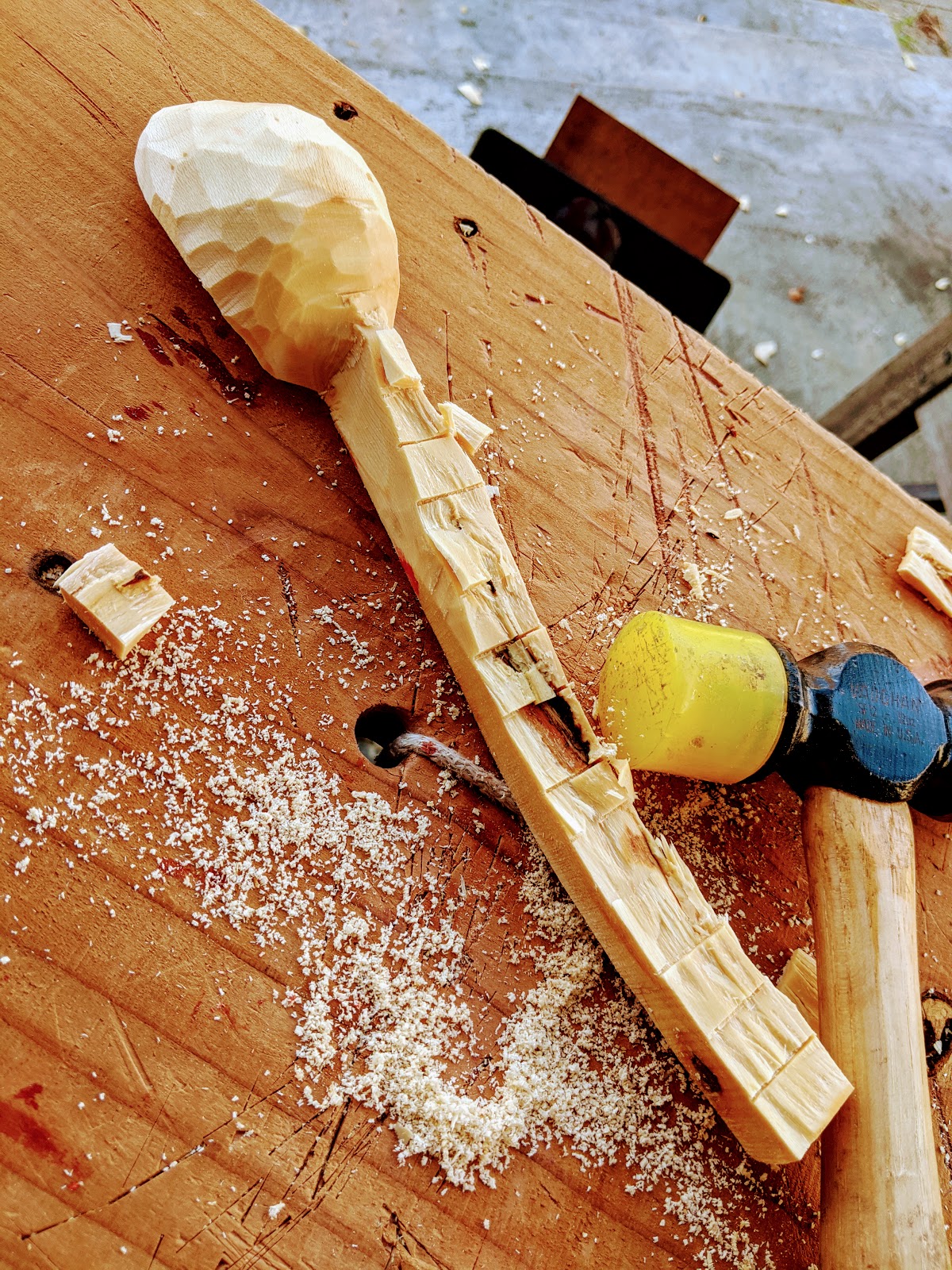
Some folks like to carve out the outside of the bowl BEFORE cutting the inside. i've tried both today and have to say that making the bowl first is a bit easier for my process. i think it has to do with having the wood as a billet underneath which makes it more easy to clamp to my knee bench with the rope-holddown. i then find it easier to pare away the outside of the bowl afterwards, using stop-cuts and just carefully paring away with a very sharp chisel.

here, i use the back of my gouge to check symmetry of the bowl

i'm establishing the overall shape of the spoon here. the grain kind of tells you what the shape of the handle should be. following the grain reminds me so much of shaping oak chair spindles in Jonesborough, Tennessee.

Sunday, March 29, 2020

carving spoons from a recently limbed street tree

while on my morning jog today, i found this limbed tree near my house with a few promising branches. i don't know what the species is, but the limbs looked pretty fresh. so after returning home from the run, i rolled out on my bicycle with my ryoba saw to cut a few useful sections for spoon carving. i wish i snapped a shot of the tree and it's leaves. it's actually a pretty nice carving wood in green.

My first spoon from the wood was not so well planned, as it had the pith running through the handle. good practice tho.

this other spoon i made today originates from a crook in one of the branches where there was a bifurcation off the leader branch. the fibers all run collinear with the crank in the spoon. it's something i have not had a lot of experience with, carving directly from the tree, but for me i receive good feedback from the grain in the wood to "tell" my knife where to go. this also means you can't just apply a "spoon template" to the wood and force it to obey the lines. you have to flow with it and let the spoon emerge from the wood. believe me: hours can pass in the blink of an eye while engaged in this work.
got a few cuts on my thumbs over the past few weeks, so today i'm applying some athletic tape to just add a little extra protection. it's helpful.
the new kuska knife made short work of this green wood. with both edges of the hook being sharp, it has numerous hand positioning and force direction possibilities. i'm still learning this tool, but so far, very happy to have it in my kit
The rest of the photos are just showing the roughing out of these pieces.

a soup ladle in poplar

had a few thick billets of poplar from my bed project. i thought, being poplar, that it'd be super easy to carve, but it was much harder than what i expected. possibly due to being so dry?
i used a 3/8" forstner bit with my drill to hog out most of the bowl. here, i'm using a long-handled hook knife (used with two hands).
From here on, it's small refinements getting this spoon to its final shape.
----f
Marc, my neighbor, brought a spoon he carved from apricot wood decades a few decades ago when he was in NM.

Friday, March 27, 2020

an attempt at a fork to go with the spoon

these are eatin' size utensils. my colleague steve said i should branch into forks so here it goes. the tines are pretty delicate, but they are wider in profile than they are in plan view. maybe they will last. better keep that steak below medium-rare

Monday, March 23, 2020

a fork to stand up to the spoon

I decided to make a fork in a similar shape to the spatula from earlier, and then this might become utencils for serving vegetables/salads.

question of the afternoon: 3 or 4 fingers?

i went with 4, but briefly ended up with 3

>
a bit of cleaving, and i've established where this thing is going
concluded. i don't like the shape of the tines. their length is also kinda precarious. It would be much more sturdy if they were flowing with the grain along a crook. just gotta see how it goes.

Saturday, March 21, 2020

Sapele Kitchen Utencils

after carving a few pieces of hard maple from the shop, I wanted something a little less severe, but not as soft as poplar. There were a few off cuts of sapele hanging around. While it might seem hard, it actually carves nicely. not nearly as soft as the poplar I was carving yesterday, but it still works easily with hand tools. The grain can be a bit squirrelly, reversing against your knife. It takes a bit of feel to know when to stop and cut from the other direction.

Over the week, as we all have dealt with our new restrictions, I've noticed more people outside walking, sometimes saying "hi" or just a hand wave. Sometimes we talk. Yesterday, a pair strolled by, a parent/guardian/aunt/grandma and a 10 year old on a skateboard. The kid paused and watched from the curb at me carving on the porch. We said "hi" and they continued on. Today they were passing on the other side of the street, same deal with the skateboarder, and noticed me on the porch. I waved them over.

It's awkward because normally one would want to at least be able to hold the spoon I was carving, just to get a feel. Or even, take a hold of the sloyd knives, or chisels. But it's not OK these days and so they step onto the porch, I welcome them and we keep some distance. The child's name is "Gus" and his guardian's name is "Dia" and we spend some time talking about what I'm doing with all this spoon work, and it's quite clear that Gus is very compelled by the obscure tools and how they could form a useful object from all the shavings on the deck. His favorite class in school right now is dance (Hip Hop). I let them know that they are welcome to stop by for some spoon carving introductions once "all this blows over".

I kinda like the look of my porch these days.

paring the shallow taper of the work's underside goes pretty easily just with a 3/4" chisel
when narrowing down stock, making small cross-grain stop cuts ease the hewing process. The ryoba saw i'm using has the rip teeth going cross grain. This is the vanity of taking photos of my work instead of actually doing the work (-:
And now a progression of refinements. The sapele is actually a really nice wood for spoon carving. I have NO idea if it can impose any flavor on what I'm cooking with. hopefully not.